Página inicial / Notícias / Notícias da indústria / Industrial Heavy Duty Washer Extractor: How to Choose the Right One for Your Hotel Laundry


IDIOMA

Kingstar is your trusted partner for industrial and commercial laundry equipment. We specialized in the R&D and manufacturing of high-end industrial washers, commercial washers and dryers. Meanwhile, we provide global clients with comprehensive planning, layout workflow design, and software-hardware integration services for smart laundry plants.
Notícias da indústria
Nov 05,2026
Industrial Heavy Duty Washer Extractor: How to Choose the Right One for Your Hotel Laundry
A 120-room hotel laundry washes roughly 600 kg of linen a day. Two 100 kg machines sit on the shortlist: same drum size, similar price, same delivery window. What separates them is extraction force, drum geometry and the way they are bolted down — and those three things will decide the site's gas bill for the next ten years.
Conclusion first: on an industrial heavy duty washer extractor, G-force and drum volume-to-load ratio set your drying and utility cost, while the mounting system decides whether the machine can be installed where your laundry room actually is. Sort those three out and the rest is detail.
What Makes a Washer Extractor Industrial Heavy Duty
A 25 kg commercial unit and a 100 kg industrial machine look similar in a brochure. The difference appears in year three, when one needs a second set of bearings and the other is still running three shifts a day without a rebuild.
Industrial duty means continuous work: 15 to 25 cycles a day, six days a week, with loads held at 80-100 percent of rated capacity. That duty cycle drives the specification — heavier frames, larger shaft diameters, spherical roller bearings, inverter-driven motors, and stainless steel thick enough to hold its shape after years of hot alkaline chemistry.
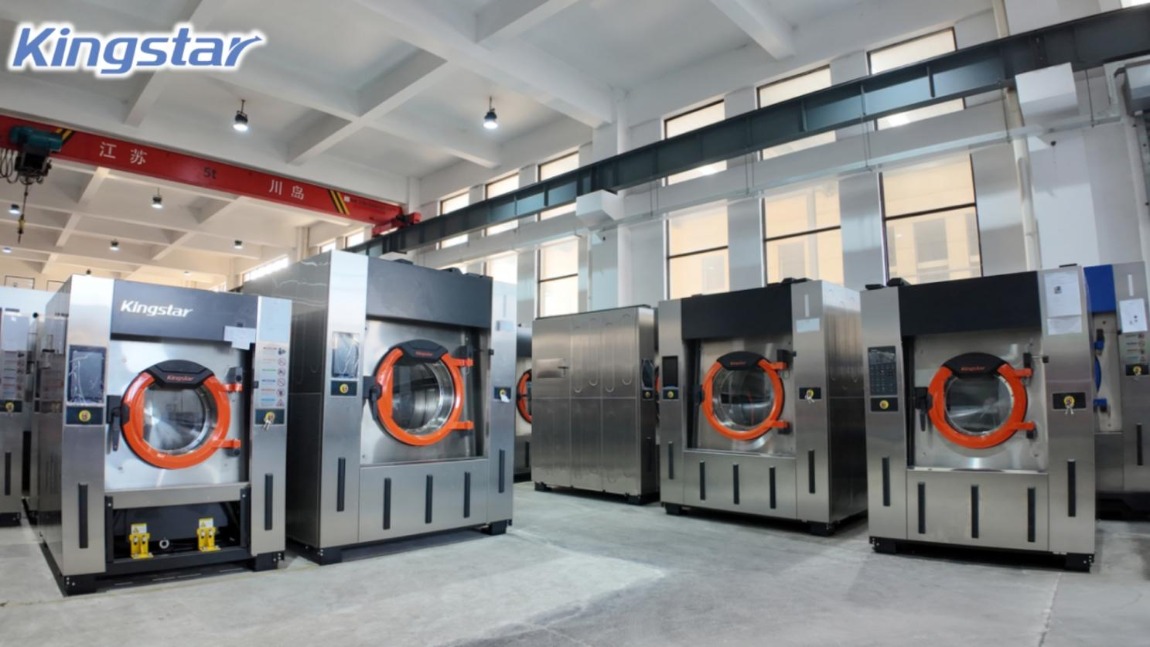
| Parameter | Commercial washer extractor | Industrial heavy duty unit |
|---|---|---|
| Drum capacity | 10-25 kg | 40-120 kg |
| Extraction force | 60-150 G | 200-450 G |
| Daily duty | 3-8 loads, single shift | 15-25 loads, two to three shifts |
| Mounting | Hard-mount on a 200 mm slab | Reinforced plinth or soft-mount suspension |
| Drum volume-to-load | About 1:12 to 1:15 | About 1:18 to 1:20 |
| Drive and control | Programme timer | Inverter drive, load weighing, chemistry signals |
Mounting and Floor Load: Decide This Before You Pick a Model
Mounting is not an accessory decision. It sets the structural work, the installation cost, and whether the machine can sit on the fourth floor at all.
Hard-mount
The drum is supported rigidly by the frame and the machine is bolted to a reinforced concrete plinth, usually 300 mm or thicker. Hard-mount units cost less, are simpler to service and generally deliver the highest extraction forces. The penalty is vibration: a floor that was not prepared properly will pass noise into the rooms above.
Soft-mount
The drum floats on springs and hydraulic or friction dampers, cutting transmitted vibration to roughly 3-5 G. A 200 mm reinforced slab is often enough, which is why soft-mount machines dominate upper-floor hotel laundries and laundromats in leased retail units. The trade-off is a suspension that needs periodic inspection and a slightly higher purchase price.
The rule of thumb is simple. If the slab is thinner than 250 mm and the laundry is not on grade, specify soft-mount. If you have a ground-floor plant room with a real foundation and you wash heavy, soiled goods such as mats or workwear, hard-mount still delivers the most extraction per dollar. Settle this at the laundry room planning stage, before the floor is poured.
 Kingstar Smart High-Speed Industrial Washer-ExtractorIndustrial washer-extractor with up to 400G extraction and 30–100 kg capacities, relevant for evaluating moisture retention and dryer load.View Product →
G-Force and Residual Moisture: Where the Operating Cost Is Set
G-force is the centrifugal force applied at maximum extract speed, expressed as a multiple of gravity. It is the best single predictor of how much water is still in the goods when the door opens — and every kilogram of water left in the load has to be boiled off in a dryer.
Residual moisture in cotton linen after extraction, by G-force
80 G
200 G
300 G
400 G
The gain is not linear, but the direction never changes. Moving from a 200 G machine to a 400 G unit typically leaves 8 to 12 percentage points less water in cotton linen, which shortens drying cycles and lowers energy per kilogram. A Kingstar plant study of dehydration rates and drying costs reaches the same conclusion from the operating budget side.
Two cautions. Compare G-force claims only when they are quoted at rated load and top extract speed, because some datasheets publish no-load figures. And high G is only worth having if the shaft, bearings and suspension are engineered for it; otherwise the savings simply move into the maintenance account.
Capacity, Drum Volume and Realistic Daily Output
Rated capacity is a dry-weight figure, and it means little without drum volume. Professional practice puts the drum volume-to-load ratio at about 1:18 to 1:20 — roughly 18 to 20 litres of drum space for every kilogram of dry goods. Below 1:15, linen has no room to fall, mechanical action collapses and wash quality becomes unpredictable. Plan loads at about 80 percent of rated capacity for cotton, and 70-75 percent for bulky items such as duvets and mattress protectors.
| Rated capacity | Drum volume | Output per 8-hour shift | Typical site |
|---|---|---|---|
| 25 kg | Approx. 250 L | 400-500 kg | Small hotel, spa, restaurant linen |
| 40 kg | Approx. 400 L | 700-900 kg | Mid-size hotel, commercial laundry |
| 60 kg | Approx. 600 L | 1,000-1,300 kg | Laundry plant, clinic, large kitchen |
| 100 kg | Approx. 1,000 L | 1,800-2,400 kg | Large hotel, industrial laundry |
| 100 kg barrier | Approx. 1,000 L | 1,800-2,400 kg | Hospital, pharmaceutical, food processing |
When your daily tonnage falls between two sizes, buy the larger machine and run it at partial load on bulky goods. A 100 kg drum working at 60 kg is a better day than a 60 kg machine pushed to its limit every cycle, because the smaller unit spends far more hours at maximum stress.
 Kingstar Industrial Dryer Custom SeriesIndustrial dryer with 40–100 kg capacities and sensor-based humidity control, suited to large loads and reducing over-drying in busy laundry operations.View Product →
Barrier Washers for Hygiene-Critical Sites
Hospitals, care homes, pharmaceutical plants and food processors cannot let soiled and clean linen share a room or a door. A barrier washer splits the machine with a wall-mounted partition: staff load on the dirty side and unload on the clean side, with interlocked doors that never open together. Common sizes are 50, 70 and 100 kg.
Budget for the wall, not just the machine. Barrier units cost more per kilogram of capacity, and the opening must be built to the manufacturer's drawing — request that drawing before construction starts, not after.
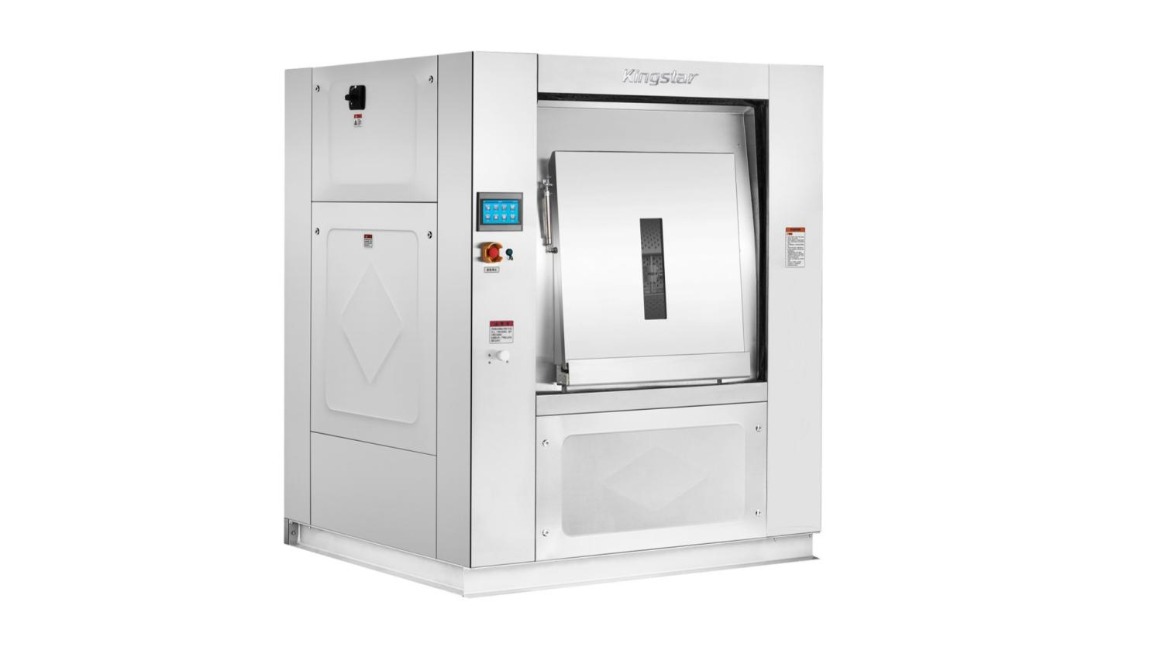
 Cleanroom Barrier Washer with Dual-Compartment IsolationWall-mounted barrier washer for 50–100 kg loads, separating soiled and clean zones to prevent cross-contamination in cleanroom and hospital laundries.View Product →
Utilities and Installation Checks
Most installation surprises were visible on paper months earlier. Confirm the following before the machine ships:
- Floor loading: the extract phase imposes a dynamic load of roughly 1.5 to 2 times static weight, so a fully loaded 100 kg machine can put well over 1,500 kg onto the slab.
- Water supply: line pressure of about 0.2-0.6 MPa and enough flow to fill the drum within a few minutes; separate hot and cold inlets reduce heating cost.
- Drainage: a 3-4 inch gravity drain or collection trench able to empty the drum in under 60 seconds.
- Heating method: steam, electric or hot-water coil, each of which changes peak electrical demand and boiler sizing.
- Compressed air: around 0.4-0.6 MPa for the pneumatic valves used on tilting and barrier models.
- Ventilation: dryer exhaust routing and air changes in the laundry room, especially in humid climates.
What to Verify Before You Sign
Over a two-year horizon, the purchase price of a heavy duty washer extractor usually accounts for a quarter to a third of total cost. Utilities take the largest share, with labour, parts and downtime behind them. That is why the specification sheet deserves more attention than the quotation.
Ask for these in writing:
- Extraction G-force measured at rated load, plus the drum volume in litres.
- Bearing type and brand, shaft diameter, and the drum's stainless steel grade.
- Inverter drive and load weighing, so water and chemistry scale with the actual load.
- Safety systems: door interlock, imbalance detection, overflow and leakage protection, emergency stop.
- A factory test report and the quality system behind it. Kingstar, for instance, works to ISO 9001, with ERP covering order-to-delivery and MES covering production progress and traceability.
- Warranty terms for the drum, bearings and control board, which are the failures that hurt most.
Field service matters as much as the hardware. Ask how quickly a technician can reach the site, and whether bearings, door seals and control boards are held in local stock.
Frequently Asked Questions
What G-force should I specify?
For hotel linen and general commercial work, 300-400 G is a sensible target. Below 200 G leaves too much water for the dryers to handle economically, while above 450 G only pays off when drying is the bottleneck and the foundation is properly engineered.
Is hard-mount more durable than soft-mount?
Durability comes from bearings, shaft and frame rather than from the mounting method. Hard-mount has fewer wearing parts; soft-mount tolerates weaker floors. Both last for decades when a real maintenance schedule is followed.
Can a 100 kg machine run 50 kg loads?
Yes, and it is often the right call for bulky items. Very light loads in a large drum do raise water and energy use per kilogram and lengthen cycles, so keep loads above roughly half of rated capacity.
How long does one wash cycle take?
A linen programme usually runs 35-50 minutes including fills, rinses and three extract steps. Water pressure, heating capacity and programme choice move that figure, so a 100 kg machine on a two-shift day should realistically complete 8-12 cycles per shift.
Heavy duty washer extractor selection rewards buyers who compare numbers rather than brochures. Start with the floor you already have, the soil level you wash every day and the kilograms you must process per shift — the model list shortens quickly once those three answers are on the table.


ADICIONAR:No.388 Xinggang Road, distrito de Chongchuan, cidade de Nantong, 226000, província de Jiangsu, China.
-
Telefone: +86-13917089379
-
Tel:+86-13917089379
-
Fax:+86-0513-85663366
-
E-mail:louislu@kingstarlaundry.com
produtos